The Explanation of Quantum Entanglement
This great mystery is easily explained by tiny vortices existing between sub-atomic “particles.”
As explained in the PhD Thesis in Dr Russell Moon's book, The end of the Concept of Time Part 1, what we call “particles” such as protons, anti-protons, electrons, and positrons, are really three dimensional (3D) holes at the ends of tiny fourth dimensional (4D) rotating vortices we cannot see. Because of this relationship, each end rotates in the opposite direction to each other.
“Note: this effect is demonstrated by a 2 foot piece of PVC pipe rolling across a table. From one side of the table, it appears to be rotating clockwise; while from the other side, it appears to be rotating anti-clockwise.”
REVERSAL OF SPIN:
Because the PVC pipe is made out of billions of atoms, like the links of a chain, each atom is twisted by the atom before it. Hence, a reversal in the direction of the rotation of the pipe is created out of the reversal spins of billions of individual atoms. However, the fourth dimensional vortex is one single structure. Consequently, its long length seems to reverse instantly. Its reversal also causes the other end to reverse its spin too.
QUANTUM ENTANGLED ELECTRONS:
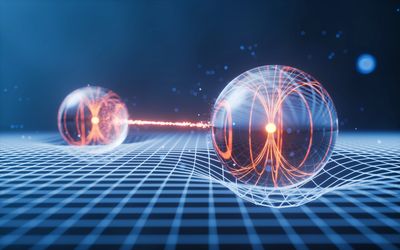
When two electrons in the valence shell of an atom touch each other, their opposite rotations in three dimensional (3D) space begin to rotate between them. When they are ejected out of the atom, the rotational 3D space between them creates a 3D vortex. Just as with the 4D vortex, no matter what its length, remains one single structure made out of the same 3D space photons are made out of.
When one end (one electron) is hit by a photon, the length of the vortex suddenly tries to lengthen. However, the mass of the electron at the other end resists its movement: resisting the lengthening of the vortex. Subsequently, the second electron emits the same amount of volume equal to the 3D volume of space the original photon contained. Making it seem as if the original photon passed instantly between the two distant electrons faster than the speed of light.
PHOTON ENTAGLEMENT:
Similar to the 3D vortices created by the two electrons, 3D vortices are created when two photons of opposite spins collide. This does not happen often because photons are dense regions of space.
This creates anti-gravity effects, causing them to avoid each other. The same effects created by these vortices are similar to those described by electron vortices = twisting one end twists the other etc.